
| Things We Learned from Pat Conroy |
|
| Written by Margaret Evans, Editor |
| Tuesday, 03 October 2017 12:35 |
|
So I'll get this party started. Pat Conroy taught me that there's something even more transformative than education, and it's the power of grace. Clearly, I'm not talking about physical grace. Though Pat was once a sleek and elegant athlete, years of hard living had already begun taking their toll when I met him in his late 40s. ("All my friends are dashing and distinguished now," I remember him telling me, "but I'm aging like some hideous crone." This was classic Conroy hyperbole, of course. He was adorable. Just not particularly graceful.) I'm talking about grace in the metaphysical, even biblical, sense. An unmerited gift. Unearned favor. Over the 25 years I knew Pat Conroy, I saw him bestow grace on one person after another - from a reader in a book-signing line, to a struggling young writer, to a stranger in the grocery store, to a neighbor in need - and I watched as those people grew strong and blossomed in the light of that grace. In fact, I was one of them. When I was younger, I believed that those of us in Pat's "circle" had somehow earned our place there - that he had chosen us, had seen something special in us that nobody else did. The older I get, the more I suspect I had that scenario backwards. In reality, I think Pat met people (often by accident), treated us as if we were special (i.e. bestowed his grace), and we, in turn, became special. We saw ourselves through his eyes - through Conroy-colored glasses - and we somehow rose to that vision. That's how grace works. Don't get me wrong. Pat was no angel. He loved to pick a fight, and he could hold a grudge like nobody's business. But never was the transformative power of grace on such bold display as when Pat Conroy forgave. I'm not talking about the everyday, ask-and-offer, two-way forgiveness we all engage in regularly - or should. I'm talking about enormous, super-human forgiveness extended to someone who's hurt you deeply and repeatedly and without remorse - forgiveness that's 100% undeserved and never even asked for. In the latter years of his life, Donald Conroy - The Great Santini - was the recipient of that rare forgiveness that can only be called grace. Despite a lifetime of heartache and abuse at the hands of his father, Pat Conroy found reserves of grace he didn't even know he possessed, and began showering that old man with it. He damn near pummeled his dad with grace. At first, Don Conroy turned away from that fierce, relentless grace. It was too bright, too disorienting. But Pat didn't stop. He sent wave after wave of grace until his father finally dipped his toe in that ocean . . . and then waded in . . . and then changed. The Great Santini actually changed. I told Pat then, and I still believe, that it was something simpler and more miraculous. I believe Don Conroy was transformed by grace.
One thing I learned from Pat Conroy: heart. To take heart. To have courage. From the Latin for heart: cor. Pat Conroy - through his writing and his living - taught me heart is the core of courage. And heart is also the core of empathy. Heart is the core, the cord - it binds us each to each in empathy. For Pat, life was heartfelt. I titled my forthcoming review of Catherine Seltzer's excellent Understanding Pat Conroy: "On Pat Conroy: The Power to Withstand, the Power to Understand." Heart links both. As Pat knew - and his life and life's work amply illustrated - heart is what gives us the power to withstand trauma. Heart equally gives us the power to understand, to come to apprehend our own suffering more fully by understanding others'. Heart conducts a power of good - to advocate, and to heal. While the binding of courage/empathy through heart courses through Pat's works, as someone who's devoted twenty years to university teaching, I particularly value the role of heart in The Water Is Wide (1972). It took great heart to stand up as a young teacher for the good of African American schoolchildren at that time, for the good of progressive education, great heart to stand with Gullah citizens of South Carolina (many of whom trace roots here back centuries) against fierce institutional prejudices and pressures targeting them. Yet the narrative shows Pat to be open-minded, too. He doesn't puff himself up into the Shining White Knight of Glorious Reform. He's aware of his own failings, his own complicities. The school board may have crucified him - fired him summarily for showing the heart to speak out against others' humiliation and his own - but he knows he's not Jesus. No, not Jesus, but I'll follow him. Sufficient unto the day is the evil thereof. Have the heart to be sufficient unto the day. One thing I learned from Pat Conroy: Live absolutely with an open heart. Bren McCl Pat Conroy taught me how to behave - not only a writer, but as a human being. Don't they go hand in hand? And I wouldn't have known the magnitude of his impact, if I hadn't experienced the complete antithesis. It happened in Atlanta, GA, during intermission at the world premiere of a play based on a famous novel. The famous novel writer was drying her hands in the restroom, and I told her, "I am enjoying the play." "Don't talk to me," she said with a voice that cut through me like a knife. And then there's Pat Conroy, yes? With his enormous heart that gives his "fans" all the time in the world, casting the light from himself onto them. I know, because I've stood in that light, been warmed by it. This is how I want to conduct myself. As a writer. As a human being. Thank you, sweet Pat.
Valerie Sayers, professor and novelist, The Powers What I learned from Pat Conroy: Give, give, give. Blurb a young protege's book. Hand sell copies of said book. Brag on younger writer extravagantly till she blushes. Buy lavish dinners. Exude warmth. Laugh hard at younger writer's awkward jokes. Buy multiple copies of your (now older) protege's book under pretense of Christmas. Sign your letters "great love." Mean it. Demonstrate with generosity that lasts years and years and won't ever die.
A quote I will always associate with Pat: "Life is a whole lot tougher than they told us it would be." From 1966, the year I really got to know him, until about 1996 - so thirty years - I don't remember him making that statement. But for the next twenty years, 1996 until the end in 2016, I heard him repeat it often. I wouldn't call the statement particularly profound, and neither would he - just a truism that we would all do well t How do we continue to lose sight of this simple reality? Many of us expect things to be easier than they are, but by the time the phrase became a mantra for Pat, life had inflicted more than his share of scars on his hide. True, he knew fame, celebrity, wealth, adoration, and honors, but also depression, anxiety, self-doubt, and regret. And yes, some of that was self-inflicted, in the way we all at times stray from what is in our best interests. A domestic life best described as chaotic (until Sandra came into it) schooled him in life's challenges, and I believe convinced him that it was impossible to live up to his own expectations. And isn't that something that makes life difficult for all of us, to discover after years of living that our youthful self-portrait is less a work of art and something closer to a crude stick figure drawn by an innocent? Pat reminded me that life is difficult, but showed it can be embraced philosophically and with humor. Always with humor. He stayed relentlessly funny, even to the end. By then he had come to know full well how much more difficult life would be than he was led to believe, but he was no less engaged in it, an example for those of us still above ground to keep in mind. Debbi Covington, food columnist and cookbook author, Celebrate Everything! The last time that I saw Pat Conroy, he was seated at a table signing books for a line of people Bernie Schein, educator and novelist, Famous All Over Town Catherine Seltzer, professor and author, Understanding Pat Conroy In Pat Conroy's hierarchy of virtue, teachers may have had a lock on the highest spot. Pat For most of us, even those who never actually sat in his classroom, Pat was that kind of teacher. But as I've burrowed in to Pat's papers at USC over the last year or so, one of the things that strikes me regularly is how profoundly committed Pat Conroy was to remaining a student too. Almost all of his journals contain at least one page filled with a list of words, for example. Pat explained that when he came across a word in his reading that had an appealing sound, or one that was new to him and that he was eager to try out, he would record it. I think it's pretty safe to say that there is no one who needed to take on extracurricular vocabulary exercises less than Pat Conroy; his linguistic arsenal was about as well-stocked as they come. But throughout his life he assigned them to himself anyway, and the lists - assemblages of words that have no link other than the pleasure they brought him - sing with a certain joy. Here's anther example: in one of our later conversations, Pat talked about his delight in reading Frances Mayes' The Discovery of Poetry. The book is marketed as an introduction to poetry, and most of the works it contains were already familiar to him. (Poetry was a part of Pat's regular diet, and I'm not sure I could give a number to the times that I blushingly confessed I didn't recognize a reference he had casually tossed off.) He dove into the book though, talking enthusiastically about how Mayes' pairing of poems allowed him to read them in new ways, for instance, and how the book ultimately invited him to think about language more broadly. For me, then, in his role as eternal student, Pat was once again serving as a teacher. The lesson wasn't found in the fact that Pat was still learning things - we all are, ideally - but that he so persistently, unselfconsciously, and ravenously pushed himself in the area he had already indisputably mastered. Witnessing his genuine pleasure in his continuing education was a curriculum of its own.
The Endurance of Love. I grew up with Pat and most of my experience of him was informal: he and my father and their friends drinking bourbon in the living room or on the porch. Me sitting on the floor watching and listening. I learned a lot in that salon, including how to tie my shoes! As importantly as that (and do not tell small child that shoe lacing is not important - it is the first independence!), Pat modeled and, therefore, encouraged one to be disarmingly passionate - whether in the right or in the wrong. If one is consistently and fiercely passionate, your friends will still love you and your enemies will just be confused. Mostly, though, in the friendship between him and my father, I was a front row witness to, and became a student of, the endurance of love.ÃÃÂ Cate Lineberry, author, Be Free or Die: The Amazing Story of Robert Smalls' Escape from Slavery to Union Hero While I never had the honor of meeting Pat Conroy in person, I've known him for most of my
Many say that all his books center around his conflicted relationship with his father in one way or another. But to look at Pat's senior year annual, you'd never know he had a care in the world. Besides being a star athlete, he was Senior Class President, Best All Round, May King, and Mr. Congeniality. As a docent at The Pat Conroy Literary Center, people often ask me if I [or any other classmates] knew he was destined for greatness. Of course not. We were all just awkwardly making our way through our teenage years. But when I look back in my 1963 annual, his senior [my sophomore] year, maybe there's another clue to the person he became. While most people were scribbling phrases like "stay your sweet and cute self," Pat wrote these words to me: Dearest Stephanie: Good Frenching, the language that is . . . Pat. I blushed and laughed then, just like I did almost every time we talked in the ensuing years. For a kid who had only come to Beaufort in his junior year, he was something else. The Pat Conroy Literary Festival is October 19-22 in Beaufort. For more information and a complete schedule of events, visit www.patconroyliteraryfestival.org |
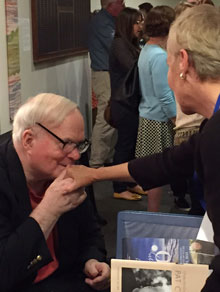 The second annual Pat Conroy Literary Festival is
  almost upon us, and this year's theme is The Transformative Power of Education. In honor of that rich subject, I asked a random handful of festival presenters to ruminate on "one thing" they learned from Pat Conroy, through his writing or his life. It was a tough assignment; I know, because I made myself do it, too. As the wonderful submissions poured in, I was surprised, but also relieved, to find that nobody chose my one thing. Whew!
 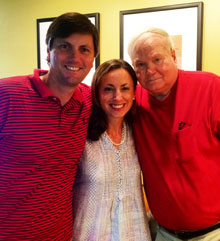 Daniel Cross Turner, professor and author, Southern Crossings: Poetry, Memory, and the Transcultural South
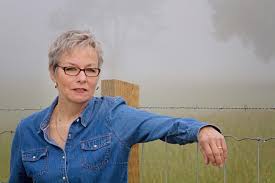 ain, novelist, One Good Mama Bone
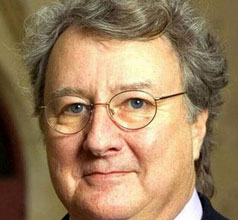 Bud Ferillo, producer and director, Corridor of Shame: The Neglect of South Carolina's Rural Schools
 that seemed to be a block long. It was at the opening reception for his 70
 Like all great teachers, Pat opened my eyes not only to the suffering of abused children, but to the incomparable beauty of my home town which, like most kids, I simply took for granted. The riverbank was an azalea-festooned obstacle course for our bicycles, the Beaufort River a place to swim, the grandiloquent oaks a hanger for our rope swing from which we sailed out over the river.
 made it clear, in his work and in conversation, that the best teachers could be agents of personal revolution: they were the people who could hand you a book you didn't know you were hungry for, or articulate an idea that gave shape to vague observations that wouldn't otherwise cohere.
 Maggie Schein, researcher and author, Lost Cantos of the Ouroboros Caves
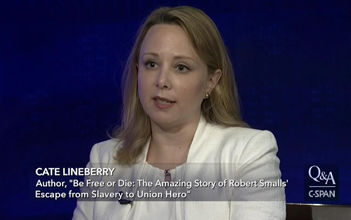 life through his lyrical storytelling - and, like so many other writers, was inspired by it. His ability to craft rich and complex characters while bringing South Carolina's lush Lowcountry to life was extraordinary and will likely never be matched. But what I most admired about him was his fearlessness as a writer. He was not afraid to mine his painful past to create his stories and, in doing so, captivated readers like me who felt so strongly connected to his novels and the deep emotions they evoked.
 Pat and